Synthesis Is Now Everyone's Job
Some time ago, engineers in one of my teams estimated a piece of work at two weeks and product pushed back. At two weeks, this part would have become the bottleneck of the whole project. The topic was escalated to me and two days later even more was done than first planned.
I didn’t do anything magical. Product wanted the work done fast and engineers wanted time for higher quality. I asked both sides what they were trying to achieve and how the system worked today. The situation cleared up and several next steps became obvious, like doing some of the work upfront and automating smaller steps, with the trade-offs accounted for.
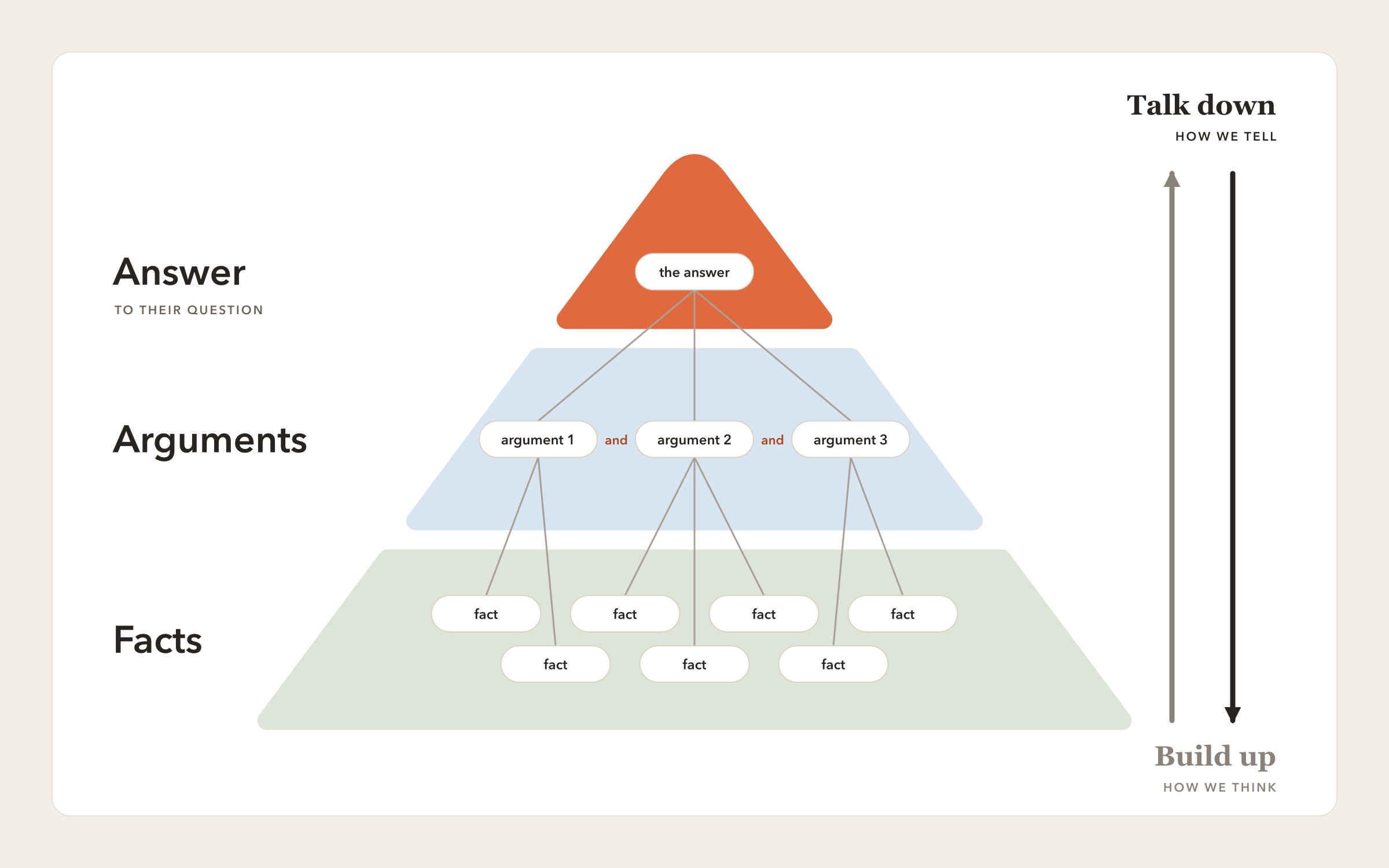
Later my manager shared Barbara Minto’s The Pyramid Principle with me and it made so much sense. Minto’s idea is to put the answer to the reader’s question on top, group the arguments that support it underneath and keep the facts at the bottom for whoever needs them.
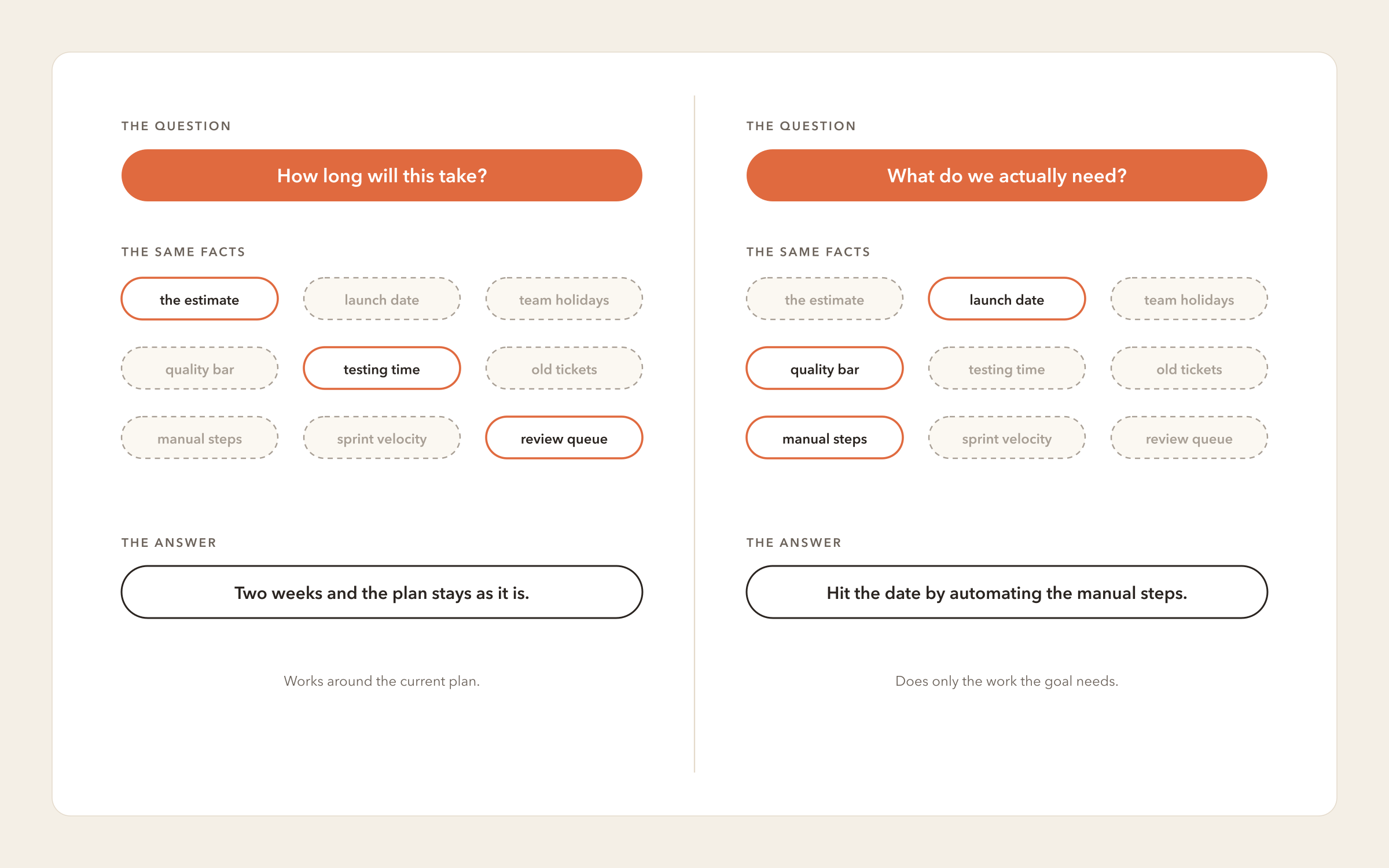
Both sides had given me their facts and neither had answered the question that mattered: what do you actually need? Each side was talking from the bottom of its own pyramid, so nothing connected the two.
Turning what you know into the answer someone else needs used to be nice to have. AI made building fast, but speed is no silver bullet when nobody agrees on what to build. Now this skill is required, for engineers as much as for anyone.
Why the Summary Used to Come for Free
On my solo projects at home I am unstoppable. I am the only one steering, my intentions and vision live in the repo and the agents can work for hours without me. When I change my mind, I adjust the docs and the agents run in the new direction. At work, many people push different parts of the product forward at once, each topic is more complex and many of them run in parallel.
Sharing full context between all of them is impossible. Fred Brooks counted it in The Mythical Man-Month in 1975: n people have n(n−1)/2 lines of communication, so ten people have 45 and fifty have 1,225. Everyone is also absorbed in their own problem and nobody can hand all of it to everyone else.
So companies did what worked: they hired more people and put them in a hierarchy, where each person talks to their manager instead of to everyone and each manager summarises for the one above. Middle managers synthesised as well as they could, so most engineers never needed to learn the skill. It had its issues, but it mostly worked.
When the Layers Thinned
We kept building faster, with better tools and frameworks, but the communication problem stayed where it was. Claude Code and the rest are just the next step in that line. Now more people can build and express their ideas in working products, but the lack of customers for vibe-coded apps speaks volumes.
Brooks saw this too. In his 1986 essay “No Silver Bullet” he split the difficulty of software into two kinds. The accidental part comes from our tools and the essential part comes from the problem itself. Every new language and faster machine removed some of the accidental part and he argued that none of them would touch the essential one. In his words, “the hardest single part of building a software system is deciding precisely what to build.” AI agents are the biggest cut to the accidental part so far, but deciding what to build is still a conversation between people and that is where the time goes.
Fewer people can now build more on their own, so teams got smaller and many of the layers between people went away with them. Meta called 2023 its year of efficiency and wrote that “every layer of a hierarchy adds latency and risk aversion in information flow”. A year later Amazon asked each organisation to raise its ratio of individual contributors to managers by at least 15%. By late 2026 smaller teams are the norm.
Everyone Became a Manager
In the age of AI we build more and communicate less. Small teams were always nimble, but now their output can match whole departments, if not companies. Some engineers push more than 250 pull requests a month and that is normal.
This only works because one person directs a group of agents that do the actual work. Directing them means making many decisions and good decisions need someone who knows the domain inside out. That expertise is what keeps the agents building the right thing.
The same pace takes away the time to learn anything else. Everyone is busy building, so nobody has time to explore a neighbouring domain and properly think it through. More things exist every week and fewer conversations happen about them. We skim and ask Claude for visual summaries, but the pile keeps growing and none of us is catching up.
So every engineer becomes a manager of sorts and ends up where managers have always been. You cannot talk with everyone about every detail, so by default the conversation moves one level up. You still go into the details with a few people, but with everyone else you talk in answers and the arguments behind them. Some people already work this way, while others still talk in facts with everyone, their leads included.
The obvious reply is to let AI summarise for us. But AI doesn’t know what to summarise, because that depends on what you are trying to decide. You cannot outsource the understanding. Addy Osmani puts it well in Critical thinking when agents do the work: “You may offload the work and much of the auditing, but not the accountability.” If AI could take those decisions for us, we would not need people in the conversation at all.
Build Up, Talk Down
We think bottom-up: facts first, then arguments, then the answer. That is how anyone works something out. Minto’s point is that we should communicate top-down, reading the same pyramid in the other direction: answer, then arguments, then facts.
Start From the Question
An answer only works if it answers something. Most communication at work happens because someone needs an answer. Sometimes the question arrives ready-made: someone asks how we enable a feature or an alert fires. Even a status report answers one, usually “what have we done and what comes next?”
Other times nobody asks and you have to find the question yourself. In my experience the quality of that question sets the quality of everything after it, because it decides which facts belong in the pyramid at all. The one I come back to most is “what is our goal here?” In the story at the top, both sides were answering “how long will this take?” when the question that mattered was “what do we actually need?”
Minto builds the whole pyramid on one question. Each level below answers the question the level above raises, usually why or how. She opens with the situation and the complication: what the reader already knows and what changed. Together they lead the reader to the question. That is all context is for. She also allows an order that starts with the answer.
For Slack I would go further. Often the question is already obvious, because someone asked it or an alert fired, so start with the answer. When it is not obvious, name the question in one line first. Everything else waits until someone asks. If you have no answer yet, say what would decide it.
Open With the Answer
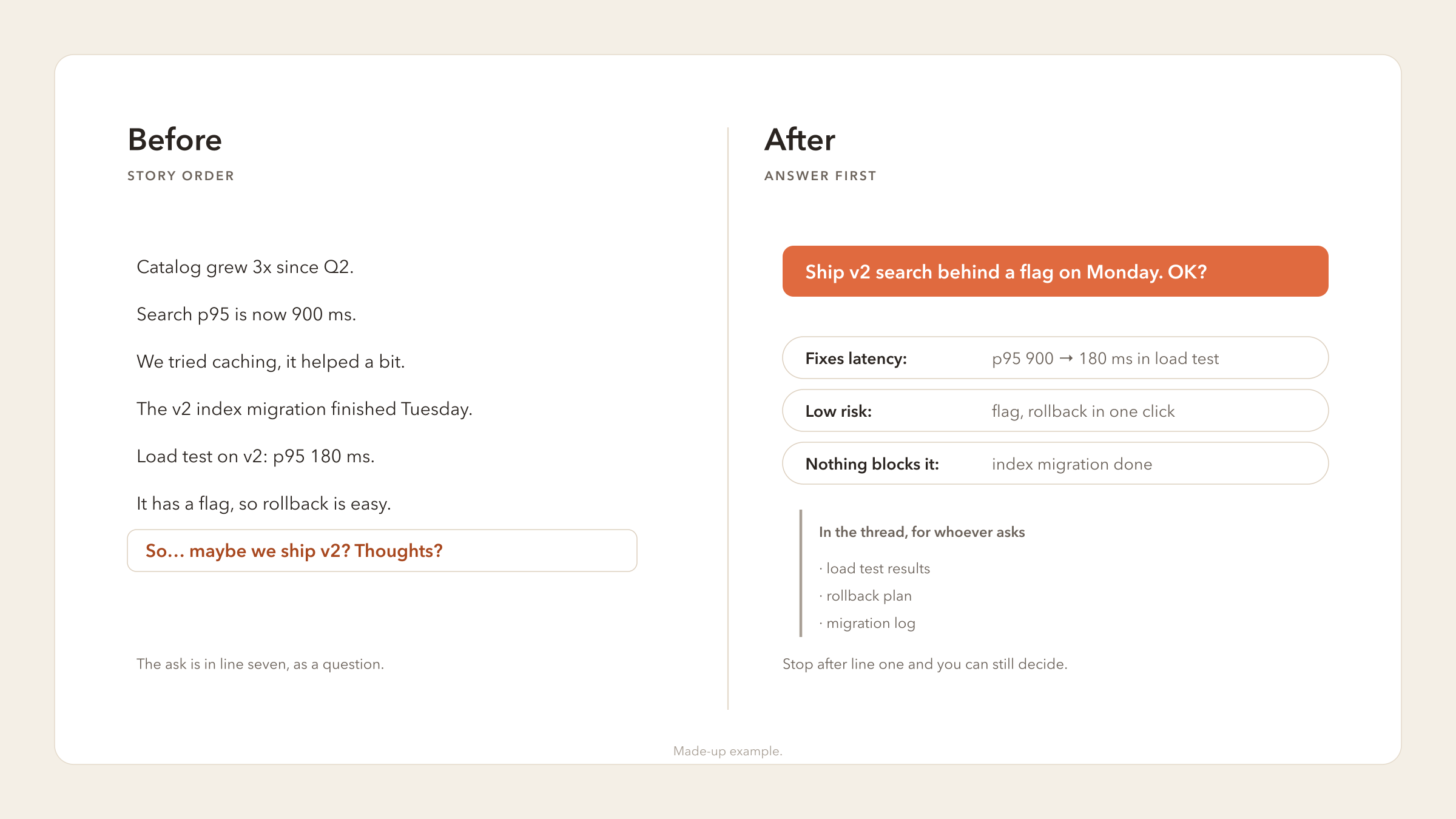
Put the answer first and give one line per argument. Say every argument before you expand on any of them and let whoever is listening decide how far to go.
In Slack this has a natural shape: the answer goes in the channel and everything else goes in the thread under it. We picked this up from Product People and it has worked well since.
An on-call reply under a 2 a.m. alert did this well. Its first line was “Resolved by itself.” Then came the cause, a write stall in a managed search service, then the impact, zero failed records and about a minute of delay, then the follow-up ticket. Anyone could stop after the first line and know they had nothing to do.
Group Arguments With “And”, Not “So”
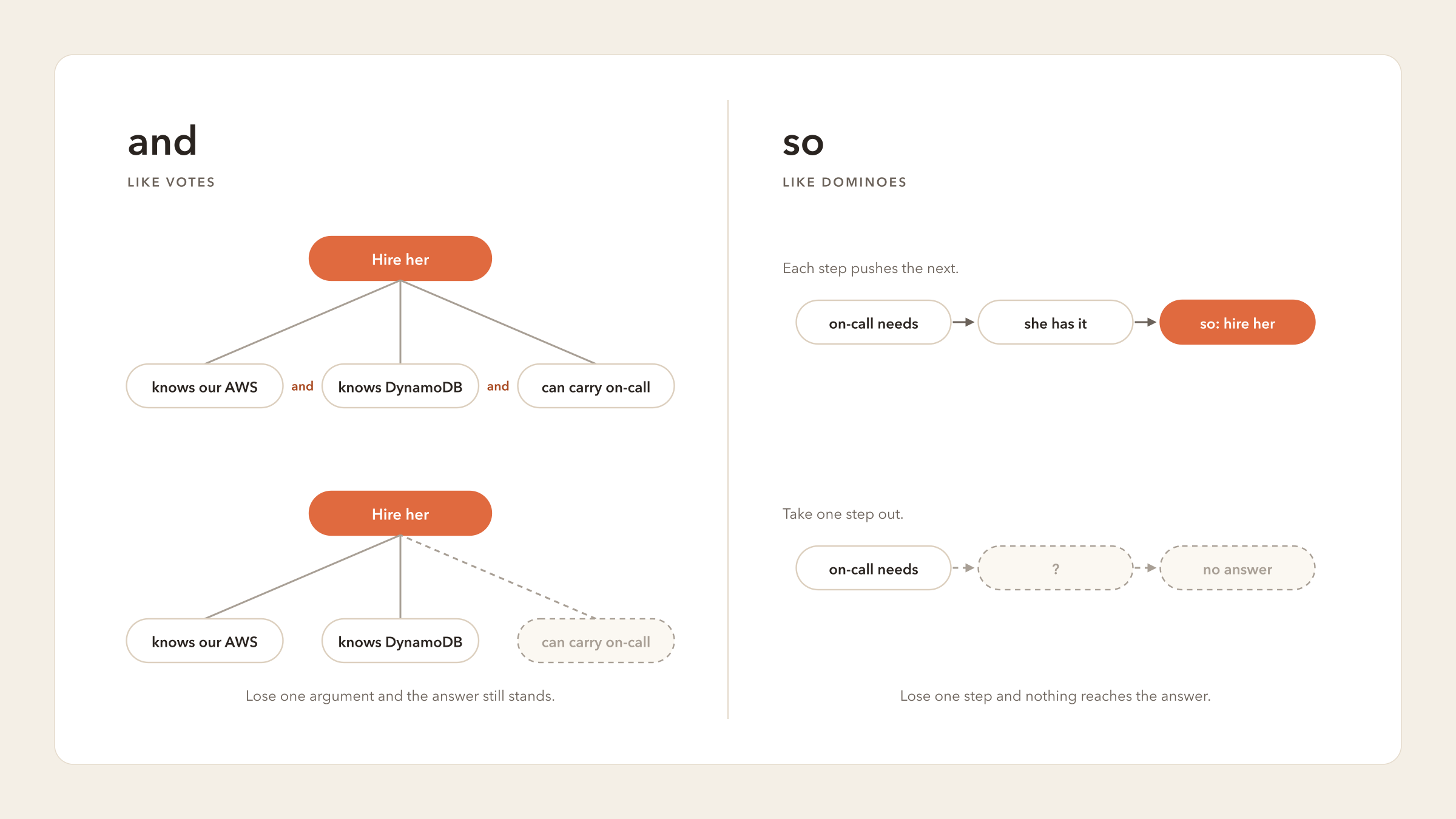
Minto calls these inductive and deductive, which sound like directions but are not. Inductive reasoning goes from several specifics to a general claim that gets likelier with every piece of evidence. Deductive reasoning goes from a rule and a case to a conclusion that is certain only if every premise holds. In plain words, a group joined by “and” or a chain joined by “so”.
Take a made-up hiring case. As a group: hire her, she knows our AWS setup, she knows DynamoDB and she can carry on-call. As a chain: on-call needs DynamoDB depth, she has it, so hire her.
With the group the reader can stop after any argument and one weak argument does not sink the answer. A chain also takes longer to tell and you can lose people on the way. It is really one argument spelled out, so compress it into one claim, “she knows the DynamoDB our on-call needs”, put it in the group and move the steps one level down.
Write Claims, Not Topics
A claim is a sentence someone could disagree with, while a topic only names what you will talk about. “Experience” is a topic and “she knows DynamoDB” is a claim. “Incident update” is a topic and “Resolved by itself” is a claim. The answer and every argument above the facts should be claims. So should every heading and summary.
A summary that only counts, like three problems or five changes, is still a topic. Minto calls these “intellectually blank”, which is harsh but fair.
Lead With Your Answer
In the story at the top I was the missing layer. I asked both sides what they were trying to achieve and put their answers next to each other, which is what a good middle manager used to do. Nobody can be in every thread, so people need to do this for themselves.
Before you send your next update, check it against this:
- You open with your answer or with “no answer yet” and what would decide it.
- If the question is not obvious, one line names it first.
- Every argument gets one line before any of them is expanded.
- The arguments stand on their own, joined by “and”.
- Every heading and summary is a claim.
- Context goes in a link or a thread reply, for whoever asks.
Then read the first line alone and ask whether someone who stops there knows what they need. The layers that used to do this for us are thinner and that is fine as long as each of us does the part they did.
Viktor Stojanov
Head of Engineering at Babbel, writing about engineering leadership in the AI-native era. Builds small Flutter products under Stojanov Ventures.